Does the market's mood decide an IPO's fate?
★ Selected for LinkedIn News This study was picked up and featured by LinkedIn News.
An observational study of US and Indian markets, 2005–2026. Not investment advice.
When SpaceX listed in June, I got curious about something I'd never actually checked: how much does the market's mood decide an IPO's fate?
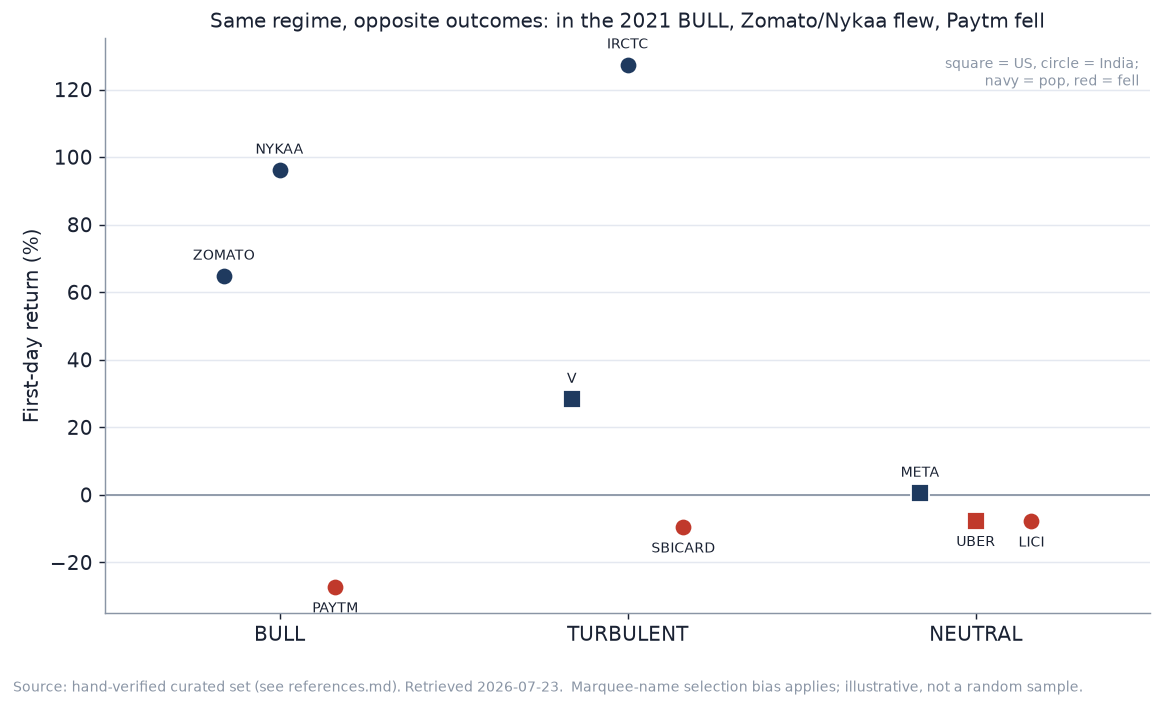
In eight days in November 2021, two Indian companies listed into the same roaring market. Nykaa closed its first day up 96%. Paytm closed down 27% — the worst debut of a major Indian IPO in years. Same market, same week, opposite fates.
That contrast is the whole study. It's tempting to read a listing off the market's mood: hot market, hot debut. The data says the mood matters — for how many companies list, and for how the average listing does. It does not decide what happens to any one of them. Price, size, and the business itself do that.
What the mood controls: how many companies show up
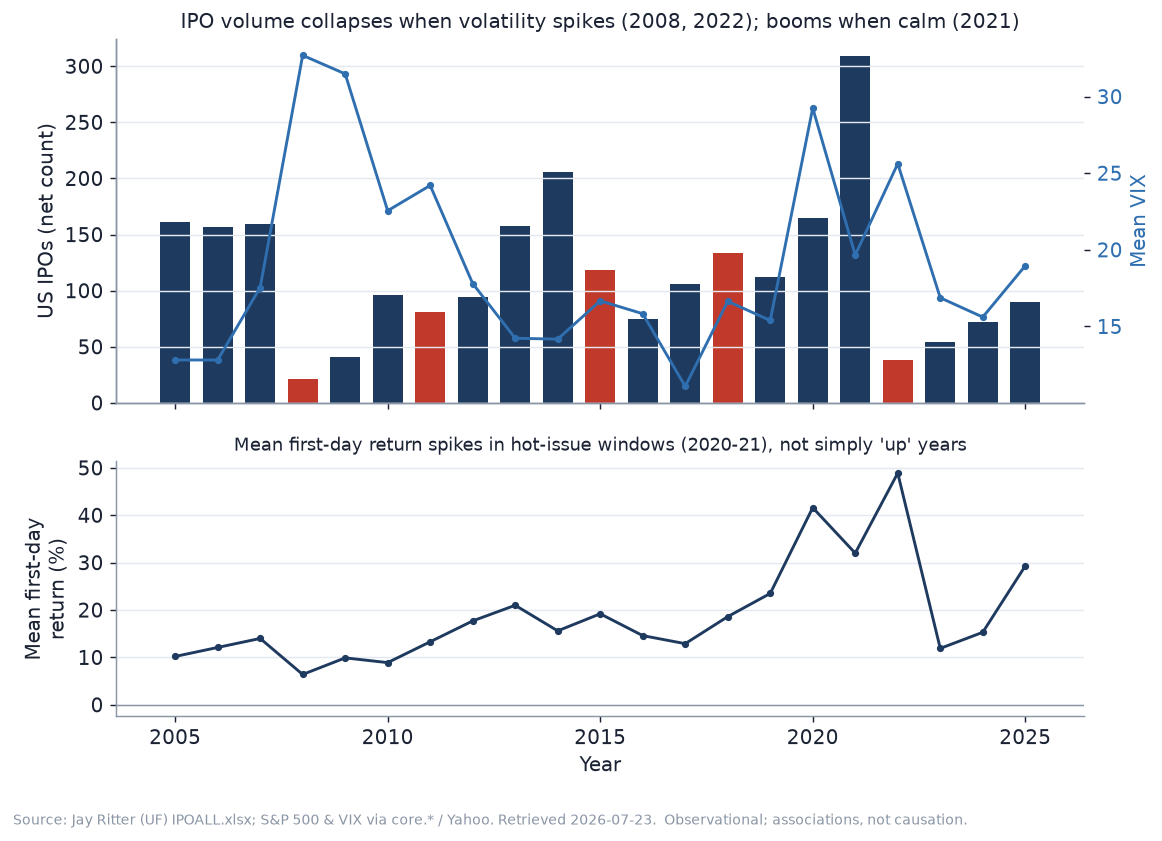
Across 2005–2025, US listing activity follows the market closely. Companies go public when things are calm and rising, and stay home when they aren't.
The extremes are stark. In 2008, as the financial crisis broke, 21 US companies completed IPOs. In 2021, with markets calm and climbing, 309 did. In 2022, as turbulence returned, the count collapsed to 38. Volume is the part of the IPO market most tied to the weather.
What it doesn't control: how well they do
Here the neat story breaks down. Across those 21 years, there is essentially no relationship between how the market did in a given year and how the average new listing performed on day one.
Big first-day jumps cluster in specific frenzies, not in every good year. The 2020–21 boom saw average first-day gains of 41.6% and 32.0% — far above anything in the surrounding rising years. Underpricing is a symptom of a feeding frenzy, not of a bull market in general.
Same market, different fates
Zomato, Nykaa and Paytm all listed into the same bull market in the second half of 2021 — Zomato in July, Nykaa and Paytm in November. Zomato and Nykaa debuted strongly. Paytm closed its first day down 27%. Nothing in the market's mood separated them; the pricing, the size of the issue, and the underlying business did.
A note on the India data
India I couldn't take as far, and the reason is itself worth stating. Two reputable sources disagreed threefold on how many mainboard IPOs India had in 2022 — one said 40, another 138 — because they count differently: mainboard only, versus mainboard plus hundreds of small SME issues. Rather than publish a number that can't be reconciled, the India aggregate was cut from the study.
So the figures here are almost entirely US, where the history is rich and consistent. The Indian contribution is that 2021 window, which happens to be a near-perfect natural experiment: three well-known names, one market, three different outcomes.
What I take from it
The market's mood is a good predictor of whether a company lists, and a poor one of how that listing does. If you want to understand a single debut, the regime is background noise. Look at how the offer was priced against demand, how much stock was pushed into the market, and whether the business justified the number. That is where listing-day fate is decided.
Code, data and sources: github.com/akshay100188/ipo-market-state-study. Not investment advice.
Have thoughts on this?
Let's continue the conversation on LinkedIn.
Get new posts by email
Occasional notes on the BA → AI PM journey. No spam.